energy.wikisort.org - Power_plant
The Thorntonbank Wind Farm is an offshore wind farm, 30 km (19 mi) off the Belgian coast, in water ranging from 12 to 27 metres (39 to 89 ft) deep.
| Thorntonbank Wind Farm | |
|---|---|
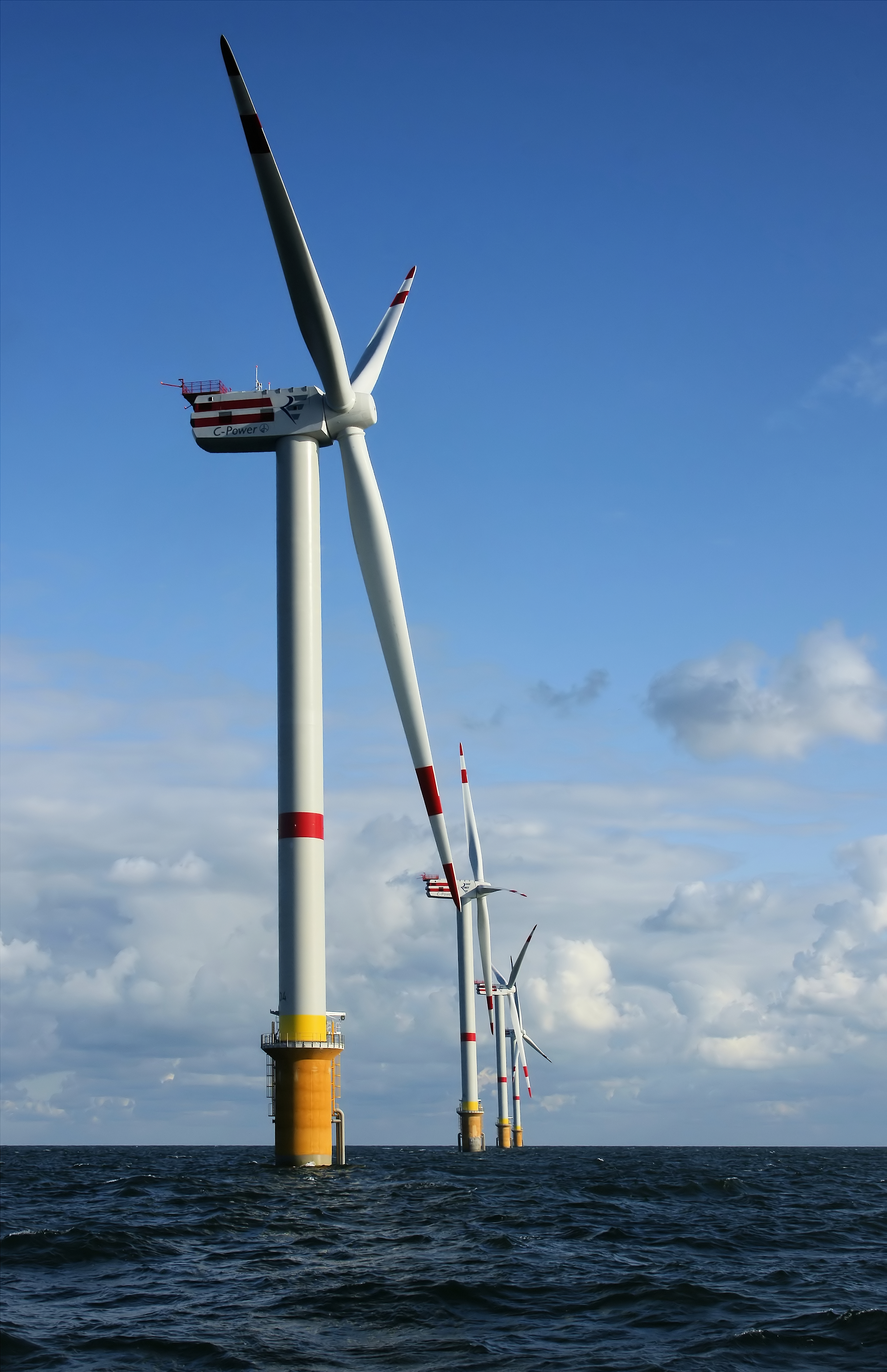 Wind turbines D4 (nearest) to D1 on the Thornton Bank | |
 | |
| Country | Belgium |
| Location | 28 km north off the Belgian coast |
| Coordinates | 51.54548°N 2.92978°E |
| Status | Operational |
| Construction began | February 2008 |
| Commission date | 18 September 2013[1] |
| Construction cost | € 1.3 billion |
| Wind farm | |
| Type | Off-shore |
| Max. water depth | 27 m |
| Distance from shore | 30 km |
| Hub height | 95m |
| Rotor diameter | 126 m |
| Power generation | |
| Units operational | 54 |
| Make and model | Senvion: 6 × 5MW, 48 × 6.15MW[2] |
| Nameplate capacity | 325 MW[3] |
| External links | |
| Website | www |
| Commons | Related media on Commons |
Electricity production started in early 2009, with a capacity of 30 MW. The capacity was increased to a total of 214 MW in 2012 and 325 MW in 2013.[3]
Phases
First phase
The first phase was built by C-Power and consists of six REpower offshore wind turbines of 5 MW capacity on the Thornton sandbank, at a cost of €153 million.[4] It was commissioned in June 2009.[5][6] A 37 km 150 kV undersea cable connects the Thorntonbank Wind Farm to the shore.[7]
The first phase of what will ultimately be a 325 MW wind farm was completed in September 2008. The six REpower 5 MW turbines, which were installed on concrete gravity foundations, were linked to the Belgian power grid, giving a total rated capacity of 30 MW for the first stage.[8] The full story of the design, engineering, construction and installation of the Thorntonbank Wind Farm (first phase) is told in an illustrated book that was published in November 2010.[9][10]
Second and third phase
In these phases, a total of 48 additional wind turbines of 6.15MWp were installed.[11]
Phase 2, completed in October 2012, comprises the installation of 30 of the 48 wind turbines.[3] These wind turbines have been installed on steel jacket foundations designed by OWEC Tower AS and assembled at Smulders, Hoboken.[12]
In the third and last phase, completed in September 2013, the remaining 18 wind turbines were installed, bringing the total capacity to around 325 MW.[3][13]
Environmental assessment
To assess the environmental impact C-Power has enlisted the assistance of the Research Institute for Nature and Forest (INBO[14]) and the Institute for Agricultural and Fisheries Research (ILVO [15]) to obtain the most detailed possible information on the occurrence of these animal species at Thornton Bank and to assess the possible effect of a wind farm on them.[16]
How the Wind Farms affect the landscape will be studied by WES-Onderzoek & Advies, who were also involved in earlier research in connection with the perceived impact on the landscape of near shore wind farms.[16]
Offshore wind farms may affect sea fishing. Certain areas may be closed to commercial fishing, as a result of which the total area that can be fished is reduced, but new habitats may also be created as a result. The basis for this study is a thorough investigation of the importance of the Thornton Bank for sea fishing.[16]
Offshore wind farms create new structures at sea and by definition they therefore pose an additional risk to the safety of shipping. C-Power has, however, chosen a location which is a long way from the most important shipping routes so that this risk can be reduced to a minimum. C-Power will be calling upon the specialised knowledge of German consultants Germanischer Lloyd.[16]
Financing
Thorntonbank was only the second offshore wind farm to be project financed.[17]
Gallery
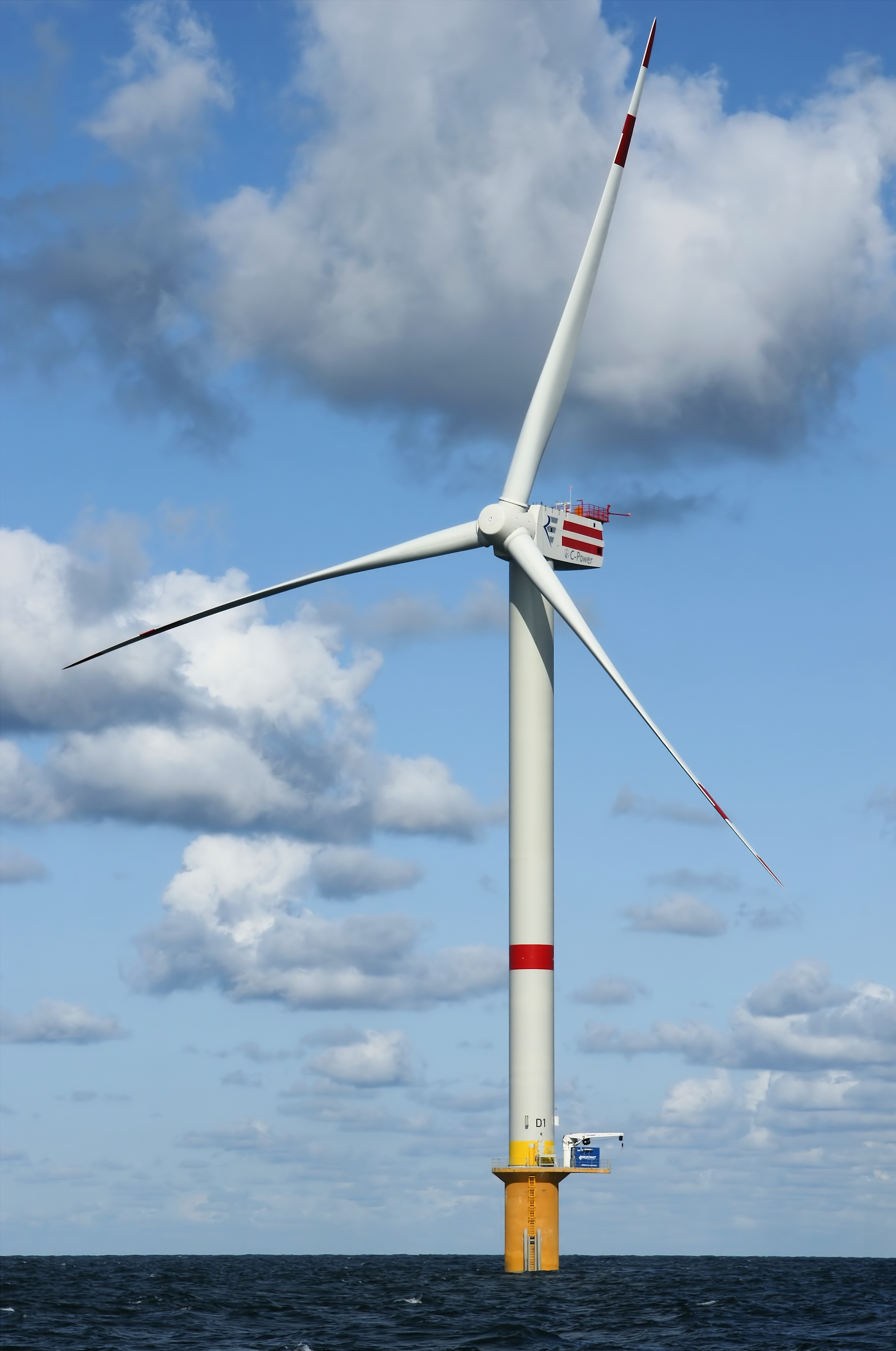
 Wind turbine D1
 Wind turbines D1 to D6
 Wind turbine bases under construction
 Wind turbine bases under construction
 As seen from the Belgian coast, demonstrating the curvature of the Earth


See also


- Belwind offshore Wind Farm (Belgium)
- Wind power in Belgium
- Energy in Belgium
- List of offshore wind farms
- List of wind farms
References
- "Belgium: Thornton Bank Offshore Wind Farm Officially Inaugurated". 18 September 2013.
- "Technology: Windturbines". c-power.be. C-Power. Retrieved 2020-08-07.
- "Project Details". c-power.be. C-Power. Retrieved 2020-08-07.
- Thorntonbank (Belgium) offshore wind farm 4C . Retrieved: 27 October 2010.
- REpower turbines to Thornton Bank offshore wind farm expansion Renewable Energy Focus, 26 November 2010. Accessed: 13 October 2011.
- Thornton Bank Offshore Project Officially Commissioned Renewable Energy World, 2 July 2009. Accessed: 13 October 2011.
- Final kick off for the 300 MW wind farm in front of the Belgian coast
- "Renewable Energy World Article". Retrieved 2009-08-03.
- Jan Strubbe, "Reuzen in de Wind - Het windmolenpark op de Thorntonbank", Tielt (Belgium), 2009, ISBN 978-90-209-8349-4
- "Presentation - c-power". Archived from the original on 2013-09-21. Retrieved 2013-09-20. C-Power phase I
- "REpower: C-Power's offshore wind farm Thornton Bank II installed" (PDF). REpower. 2012-07-27. Retrieved 6 November 2012.
- "OWEC Tower: Supplying foundations for 48 turbines and one OTS". OWEC Tower. 2013-05-20. Retrieved 16 July 2013.
- Phase 2 complete Archived 2012-07-30 at the Wayback Machine
- INBO
- ILVO
- Environmental impact Archived 2013-09-21 at the Wayback Machine
- "C-Power Financing Article Article" (PDF). Archived from the original (PDF) on 2008-11-14. Retrieved 2009-08-03.
External links

- Official website[dead link]
- Thornton Bank, RWE Innogy
- Video of the wind turbine foundations under construction on YouTube
- LORC Knowledge - Datasheet for Thornton Bank 1
Wind power | ||
|---|---|---|
| Wind power |
|  |
| Wind farms |
| |
| Wind turbines |
| |
| Wind power industry |
| |
| Manufacturers |
| |
| Concepts |
| |
| ||


Другой контент может иметь иную лицензию. Перед использованием материалов сайта WikiSort.org внимательно изучите правила лицензирования конкретных элементов наполнения сайта.
WikiSort.org - проект по пересортировке и дополнению контента Википедии